No products in the cart.
Carla Accardi (1924–2014)was one of the most influential figures of post-war Italian abstraction and a pioneering presence within the European avant-garde.
Born in Trapani, Sicily, in 1924, Accardi studied at the Academies of Fine Arts in Palermo and Florence before settling in Rome in 1946. The following year, together with artists including Pietro Consagra, Piero Dorazio, Achille Perilli, Antonio Sanfilippo and Giulio Turcato, she co-founded Forma 1, the groundbreaking group that sought to reconcile formalist abstraction with the political and cultural debates of post-war Italy.
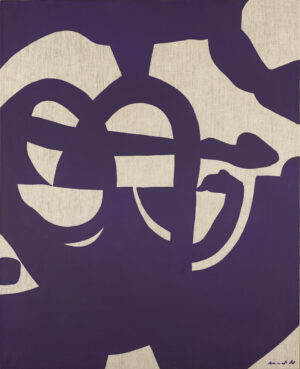
During the 1950s, Accardi developed a distinctive visual language based on rhythmic, calligraphic signs, initially working with a reduced palette of black and white. Her work attracted the attention of the influential French critic Michel Tapié, who included her in several international exhibitions associated with Art Informel and art autre.
From the early 1960s, colour returned decisively to her practice. Accardi began experimenting with vivid and fluorescent paints and, most notably, with Sicofoil, a transparent plastic material that allowed her to move beyond the conventional surface of the canvas. Works such as Tenda* (1965) and *Triplice Tenda* (1969) transformed painting into an environmental and spatial experience, anticipating concerns that would later become central to Arte Povera and installation art.
Throughout her career, Accardi continuously explored the relationship between sign, colour, surface and space while maintaining an unmistakable visual vocabulary. She was also an important figure in the Italian feminist movement and was associated with Rivolta Femminile, founded in 1970 with Carla Lonzi and Elvira Banotti.
Accardi participated in numerous editions of the Venice Biennale and was the subject of major exhibitions in Italy and internationally, including presentations at Castello di Rivoli, MoMA PS1 in New York, and the Musée d’Art Moderne de la Ville de Paris.
Today, Carla Accardi is recognised as a central figure in twentieth-century Italian art, whose radical experimentation expanded the possibilities of abstract painting and influenced subsequent generations of artists.
Showing the single result